
Agricultural production generates substantial quantities of woody residues, including branches, pruning waste, sawdust, bark, and other lignocellulosic materials. When these residues are poorly managed, they may occupy valuable storage space, deteriorate rapidly, or be openly burned, resulting in avoidable resource loss and atmospheric emissions. A wood coal making machine provides a thermochemical route for converting such biomass into a more stable and commercially useful carbonaceous material.
Converting Agricultural Residues into Stable Carbon
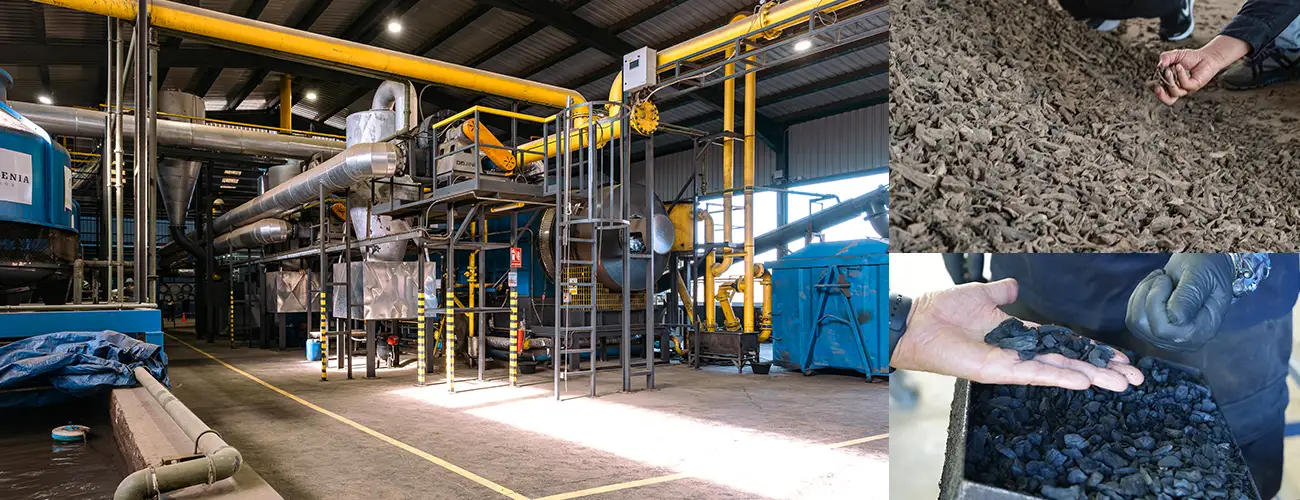
The fundamental principle behind a wood coal making machine is carbonization. Under controlled thermal conditions and limited oxygen availability, organic components in wood-based agricultural waste undergo thermal decomposition. Volatile compounds are released, while a carbon-rich solid residue remains.
Unlike uncontrolled burning, carbonization can transform biomass into a concentrated solid product while retaining a significant proportion of its carbon content. The resulting charcoal can be easier to store, transport, and utilize than bulky raw residues.
This conversion also addresses a common agricultural challenge: seasonal biomass accumulation. Instead of allowing pruning residues or sawdust to remain in open piles, agricultural operators can process them into a standardized carbonaceous product.
Reducing Open Burning and Waste Accumulation
Open burning is still used in some agricultural areas to dispose of excess biomass. However, uncontrolled combustion offers little opportunity for resource recovery and can contribute to particulate emissions and other pollutants.
A wood coal making machine establishes a controlled thermal environment for biomass conversion. The process can therefore shift agricultural waste management from simple disposal toward resource utilization.
The reduction in waste volume is another practical advantage. Woody residues contain considerable moisture and volatile matter, whereas carbonized material is substantially more concentrated. This can simplify downstream handling and reduce the physical burden associated with transporting untreated biomass.
Producing a Useful Carbon-Based Product
The output of carbonization is not merely a waste residue. Depending on feedstock characteristics and processing conditions, the resulting wood charcoal can serve several downstream applications, including solid fuel, activated-carbon feedstock, metallurgical applications, and other carbon-based products.
For agricultural enterprises, this creates an additional value pathway. Residues that previously had little direct economic value can become an intermediate product with potential commercial applications.
Process parameters matter considerably. Feedstock moisture, particle size, carbonization temperature, heating rate, and residence time can all influence fixed-carbon content, volatile matter, ash content, and overall product characteristics. Consequently, appropriate feedstock preparation and process control are important for maintaining consistent output.
Supporting Circular Biomass Utilization
Sustainable waste management depends on keeping resources within productive cycles for as long as practical. A wood coal making machine contributes to this principle by converting agricultural residues into a reusable carbon-rich material rather than treating biomass solely as refuse.
The approach can also complement other biomass utilization strategies. For example, residues unsuitable for direct combustion may be processed through carbonization, while the resulting charcoal can enter downstream industrial or agricultural applications. In this sense, carbonization functions as a bridge between waste management and biomass valorization.
Improving Agricultural Resource Efficiency
The sustainability value of a wood coal making machine extends beyond waste reduction. It can help agricultural operations establish a more integrated biomass management system in which residues are collected, processed, and converted into products with defined applications.
Such a system can reduce dependence on disposal practices while creating opportunities for additional revenue from agricultural by-products. At larger scales, centralized biomass collection and continuous carbonization can further improve logistical efficiency.
Ultimately, the wood coal making machine represents a practical thermochemical solution for managing woody agricultural waste. By converting dispersed biomass residues into a stable carbon-rich product, it supports waste reduction, resource recovery, and more circular utilization of agricultural materials.

Comments
No comments yet. Be the first to react!